Five tabs, in detail.

What each tab of the app actually does, why it exists, and what it looks like on screen.

The leaderboard that actually helps you train.

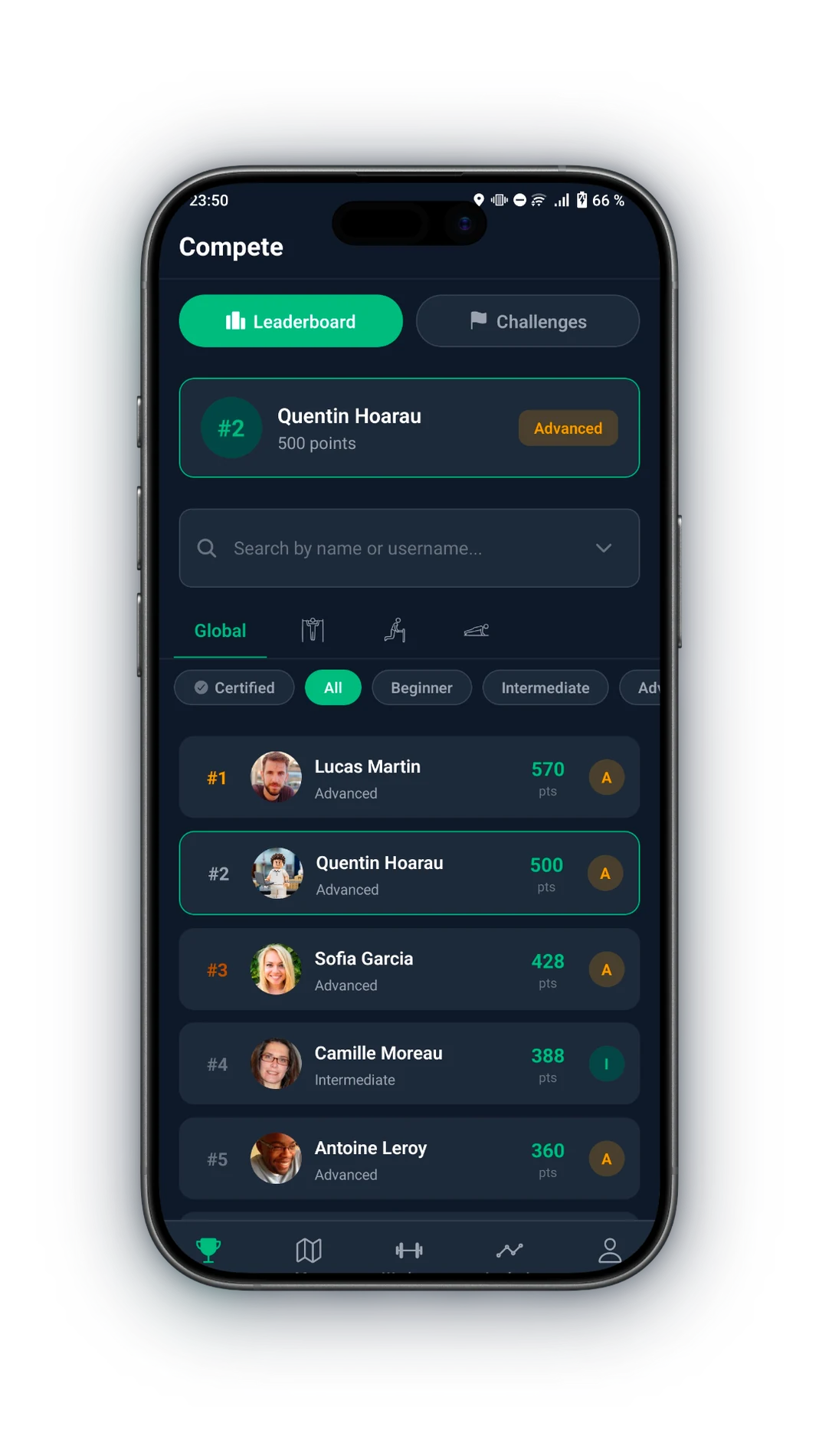
Global ranking by Onbars Score, sliced down to athletes who actually look like you.
WHAT IT SOLVES
Global leaderboards are generic. You don't know who to compare yourself to — and seeing #1 with 800 pts says nothing about the people training at your level.
HOW IT WORKS
Filter by tier and by exercise. Search anyone by name. Toggle 'certified only' to hide unverified scores. Tap a profile to see their exact stats, exercise levels, badges, and certification videos.
WHY IT MATTERS
Fair competition. You train smarter, not just harder — and you find the athletes 50 points above you to chase.
REAL FILTERS
Tier · All / Beginner / Intermediate / Advanced / EliteExercise · Global / Pull-ups / Dips / Push-upsCertified onlySearch by name
Onbars app screenshot
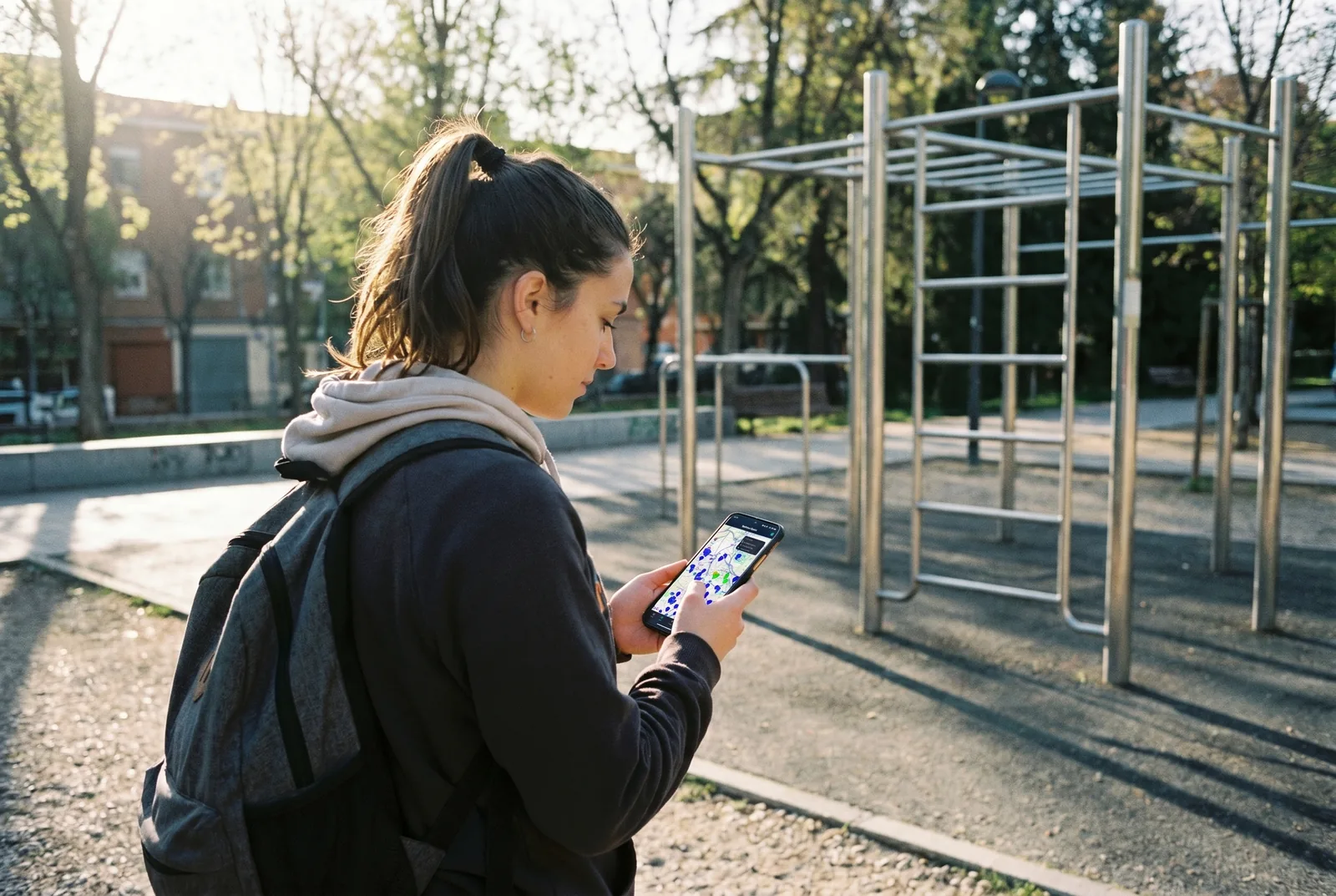
An athlete arriving at a street workout park, finding it on the Onbars map

Your next spot is on the map.

Real parks, not guesses — pulled from open map data, then checked by the athletes who actually train on them.

Find the spot. Then hold it.

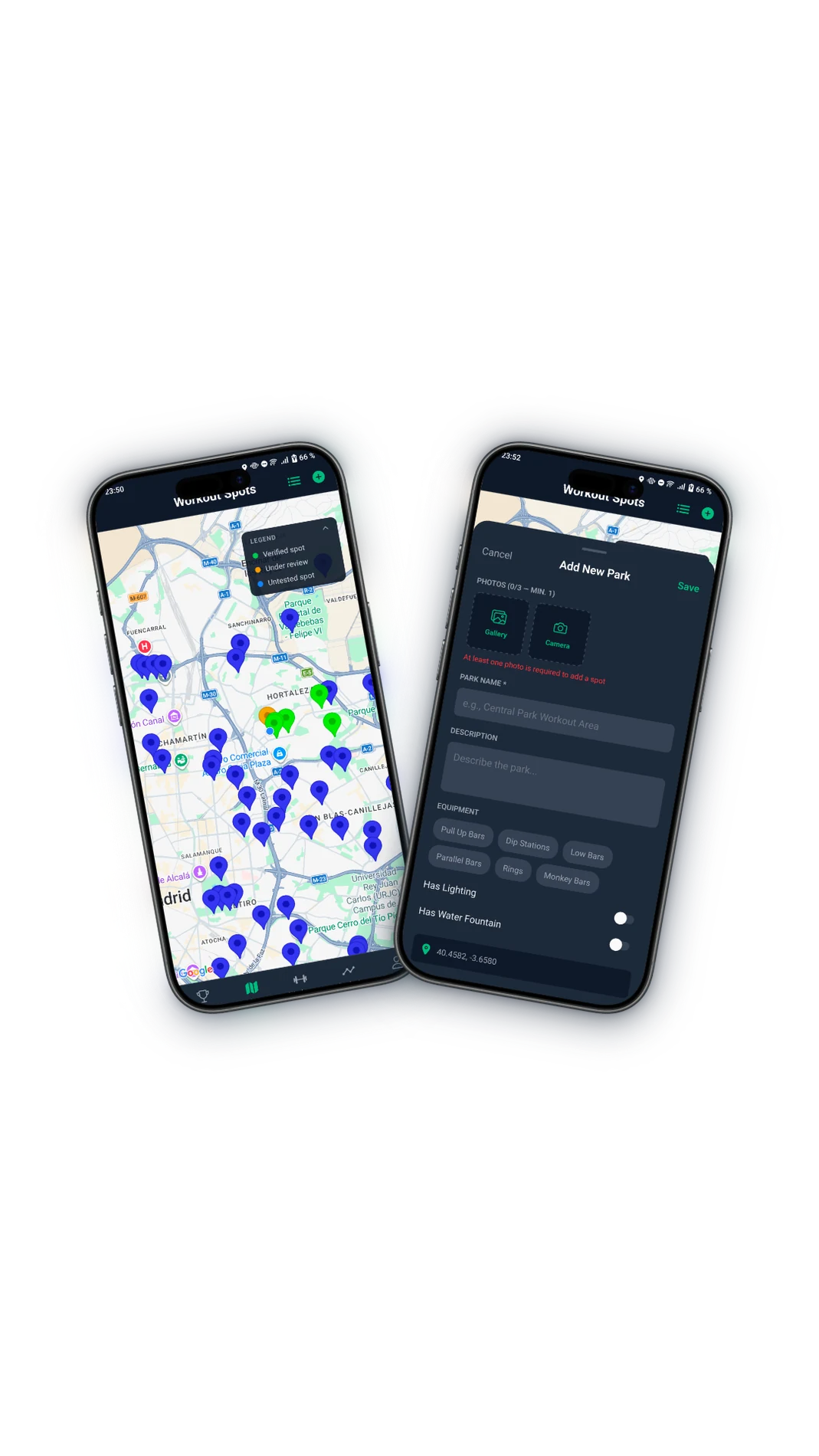
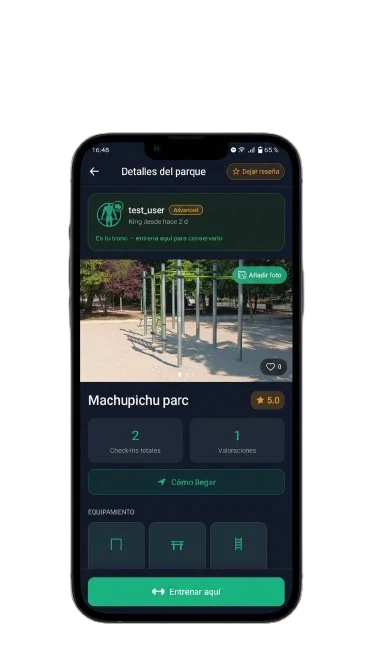
Real street workout parks, pulled from open map data and filtered hard. Live check-ins, addresses, directions — and a throne to take.
WHAT IT SOLVES
Calisthenics happens outdoors. Most fitness apps assume you're indoors. You don't know which park has a dip bar, who's training there right now, or how to actually get to it.
HOW IT WORKS
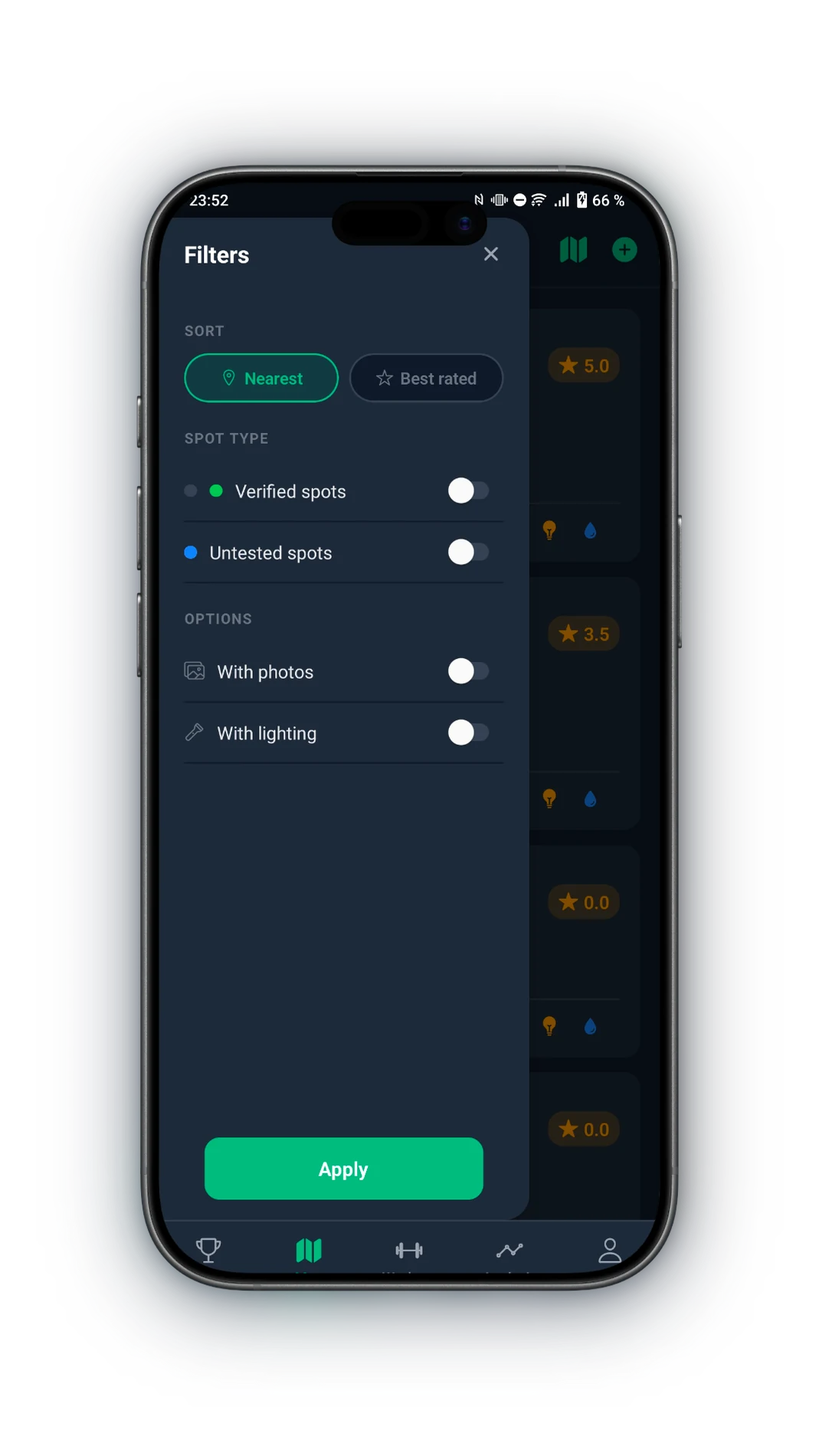
Parks come from OpenStreetMap through a strict filter, so what you see is a real calisthenics spot and not a random playground. Each park has its address, a directions button, equipment, photos and ratings. Filter by equipment, rating or distance — and add anything the data missed by dropping a pin.
WHY IT MATTERS
The community owns the map. If your neighbourhood's spot isn't there, add it. If the rings disappeared, report it. Starting in Madrid, one city deep before the next.
Verified spot
Confirmed by the community
Report in progress
Something changed — being checked
Untested spot
From map data · no one has confirmed it yet
LIVE AT THE PARK
Real-time check-inSee who is training nowAnonymous mode500 m geofenceCheck-out on leave
TERRITORY · KING OF THE PARK
CONQUER
Train at a park often enough and it becomes your territory — your name on the pin.
THE THRONE
Hold up to 3 parks at once. Stop showing up and the throne decays after 30 days.
PROOF
Your territory shows on the map and on your profile — and exports as a 9:16 card you can post.

Log it. All of it. Every set.

Built around the actual calisthenics movement tree — and now the home of live sessions and the weekly AI analysis.
WHAT IT SOLVES
Generic fitness apps don't know what a tuck front lever is. They certainly don't track L-sit holds, archer pull-ups, or muscle-up progressions. You end up with a notes app.
HOW IT WORKS
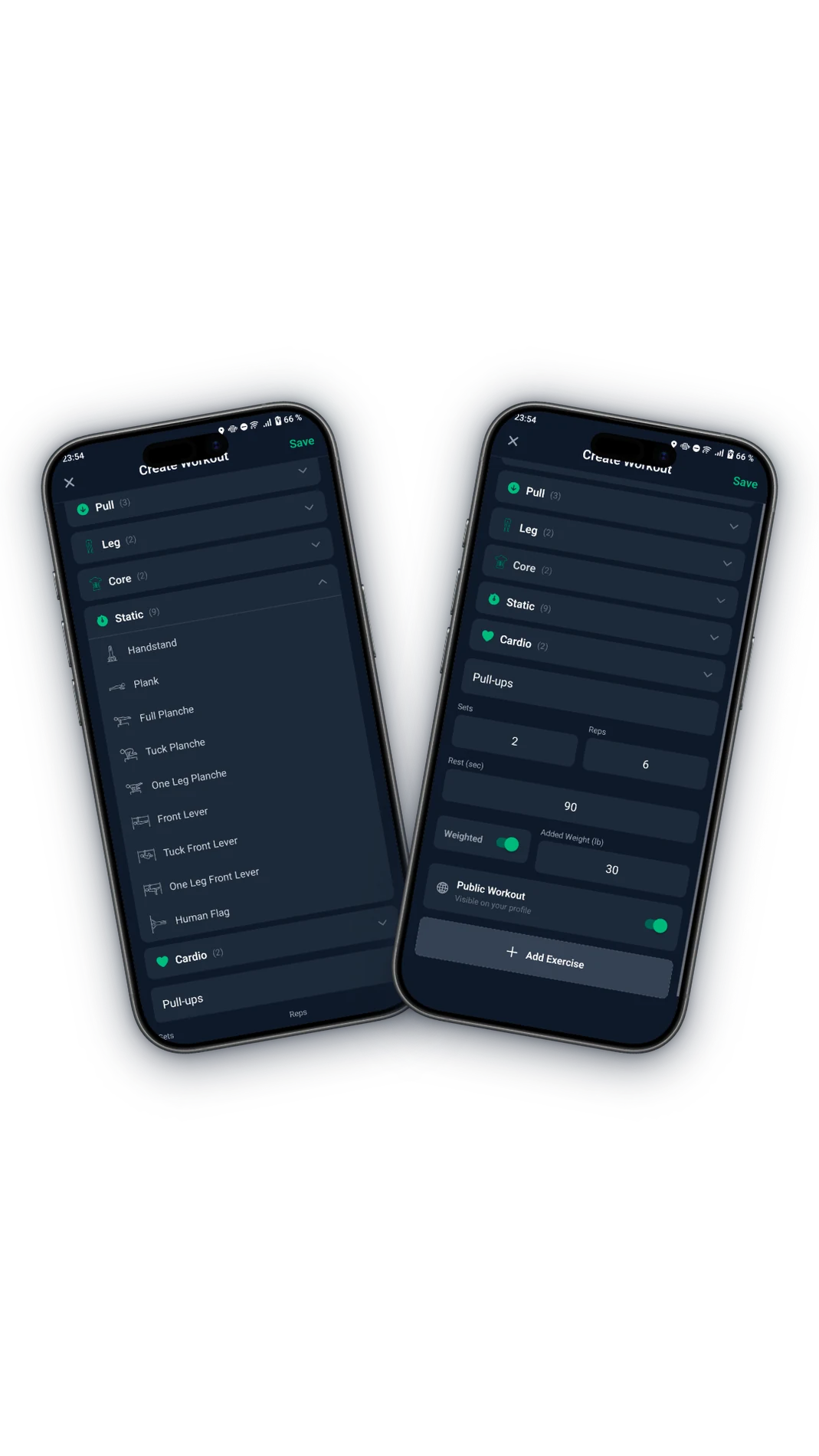
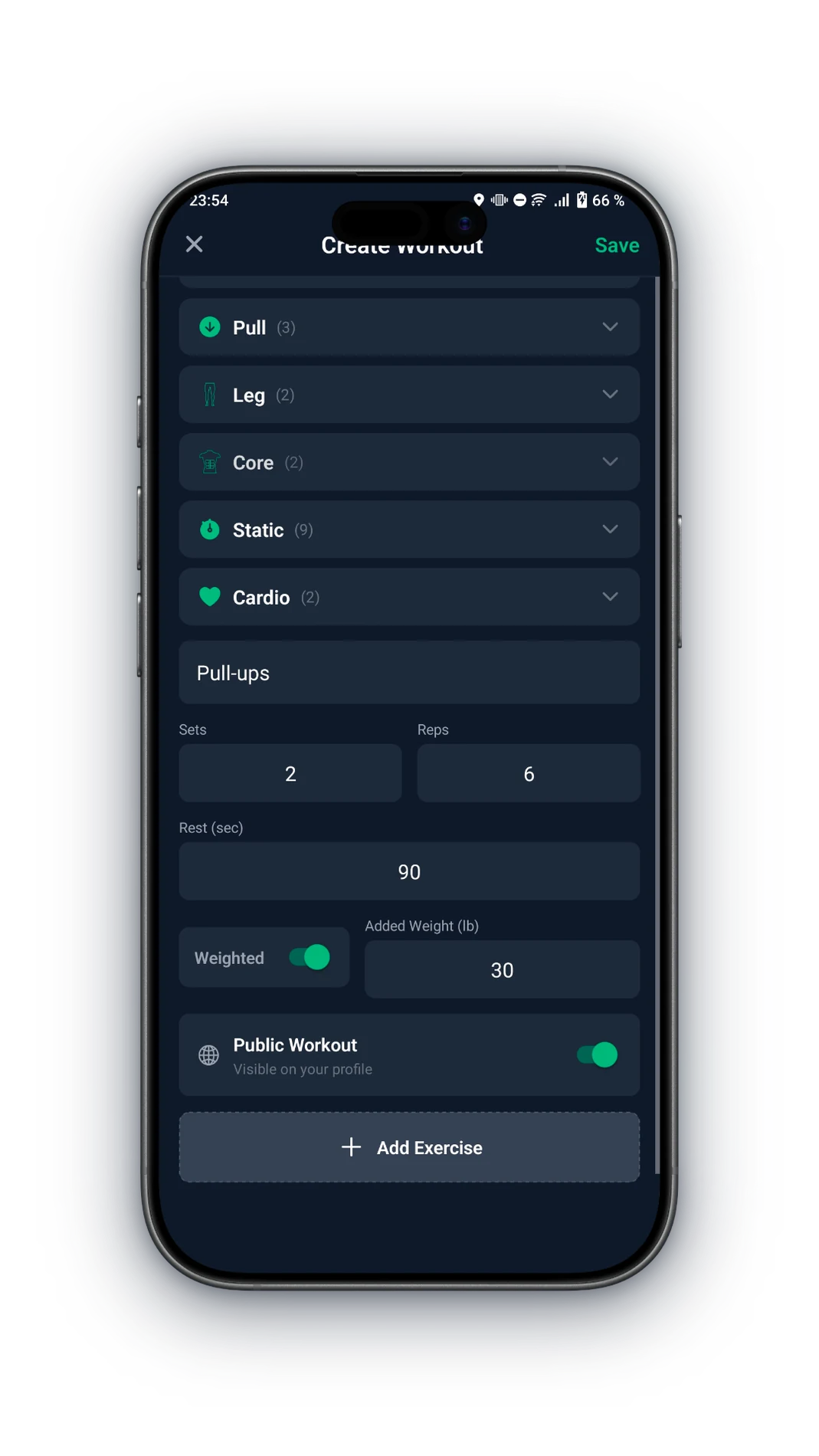
Create a routine, pick exercises from the calisthenics library, set sets / reps / weight / rest. Save it, reuse it, edit it. Every routine is yours.
WHY IT MATTERS
Progression is the whole point. When you see your pull-up max go from 8 to 12 over 8 weeks, in actual numbers, you stop chasing dopamine and start chasing strength.
EXERCISES IN THE APP — ORGANIZED BY MOVEMENT FAMILY
Push · Push-ups · Dips · Handstand Push-upsPull · Pull-ups · Muscle-ups · Australian Pull-upsLeg · Squats · Pistol SquatsCore · L-Sit · Leg RaiseStatic · Handstand · Planche (Full / Tuck / One-leg) · Front Lever (Full / Tuck / One-leg) · Human FlagCardio · Running · Jump Rope
Chalked hands gripping a steel pull-up bar

This is where it's earned.

Hit play. Train. Log nothing manually.

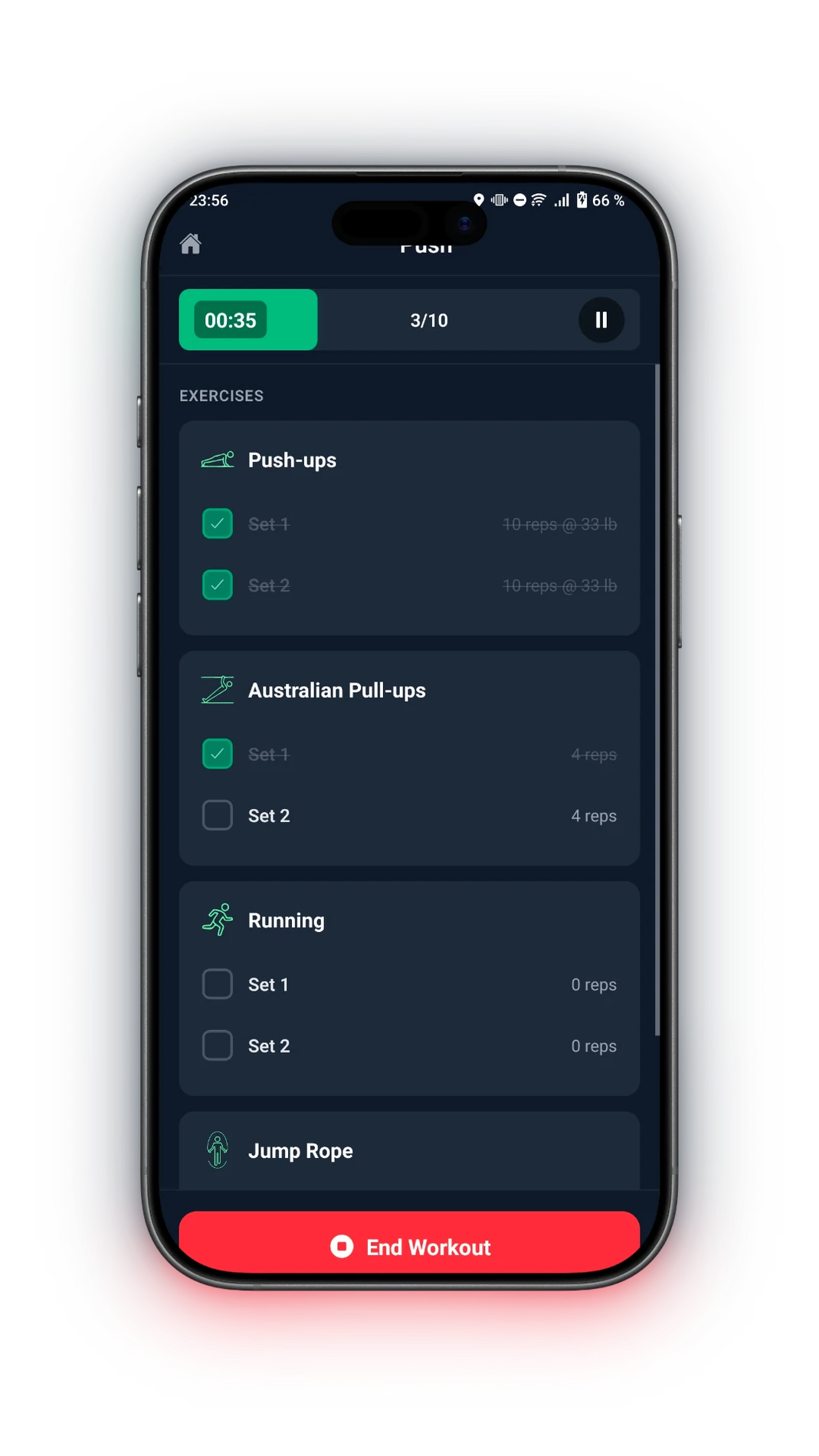
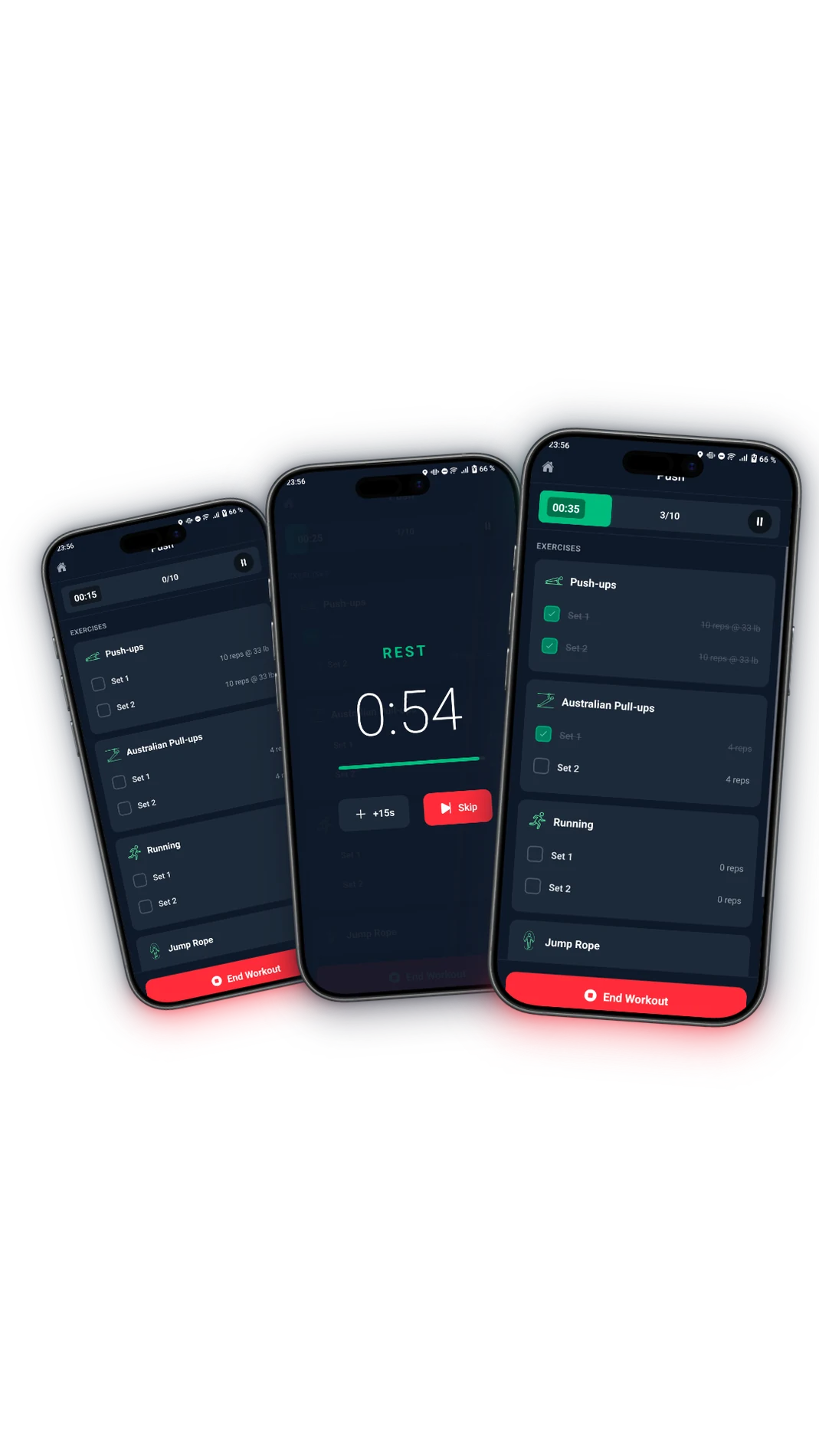
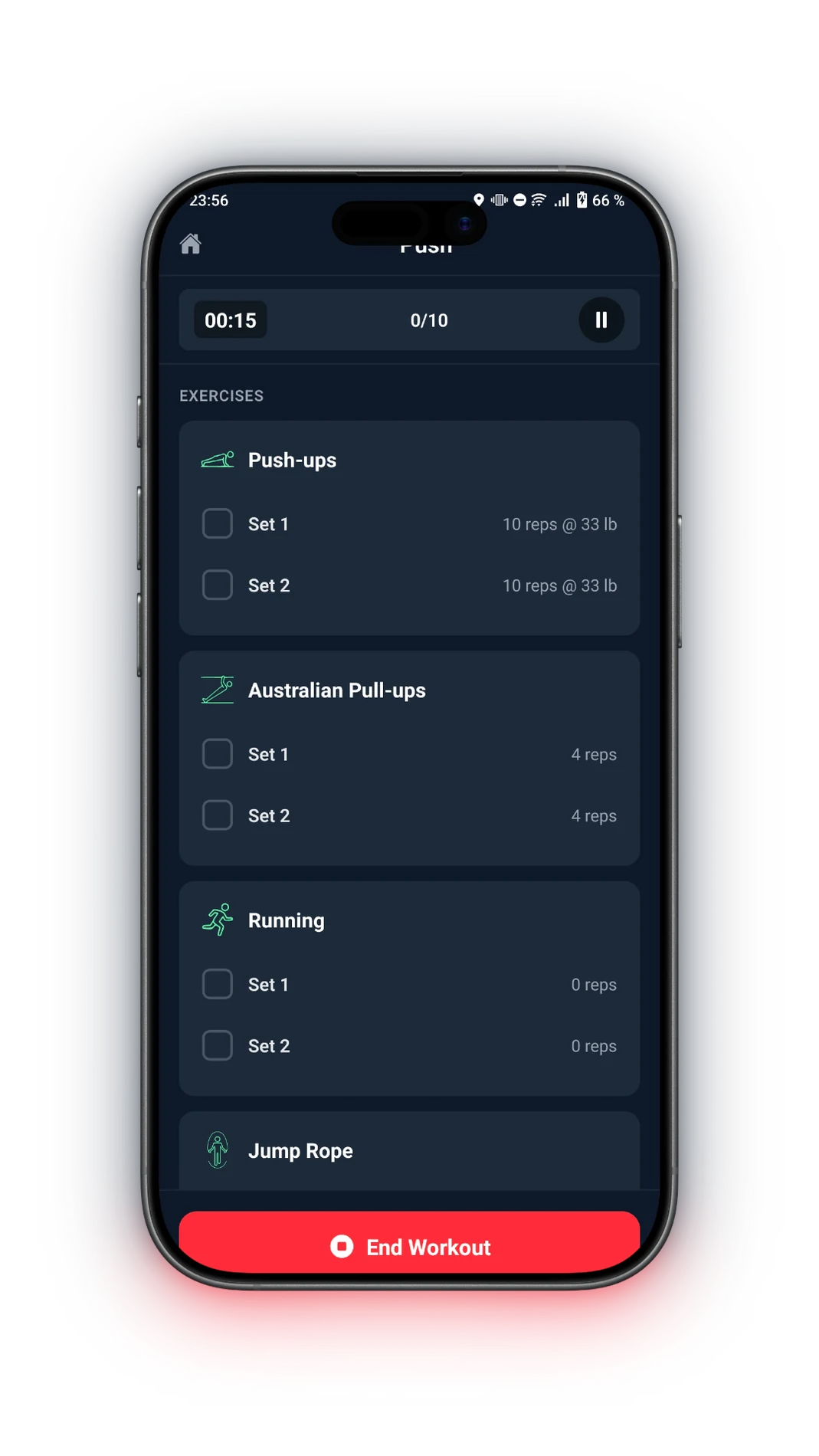
Pick one of your saved routines. The app runs the session for you — sets, rest timer, location, stats.
WHAT IT SOLVES
During a session you don't want to type. Reps, weight, rest — every tap breaks the rhythm. And tracking it after the fact means half of it gets lost.
HOW IT WORKS
Pick a routine. Choose Home or Park. Hit Start. The app counts sets, fires the rest timer between them, lets you skip rest, pause, or end early. At the end you get duration, total sets, total rest time — saved automatically.
WHY IT MATTERS
Less friction during the workout. More signal after. The data shows up on Analyze and Profile without you ever opening a notes app.
WHAT IT TRACKS LIVE
Set counterAuto rest timerSkip / Pause / EndLocation · Home / ParkTotal durationTotal rest time

The honest mirror. No flattery.

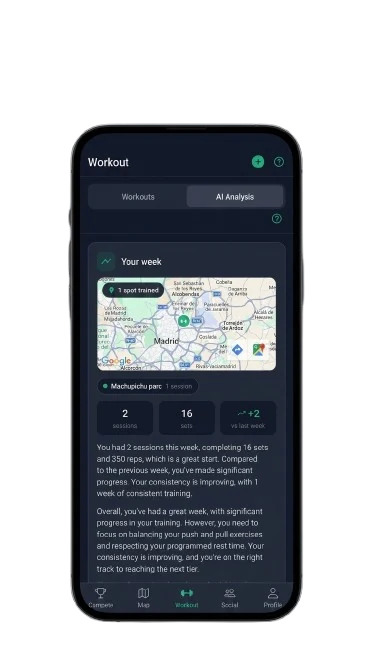
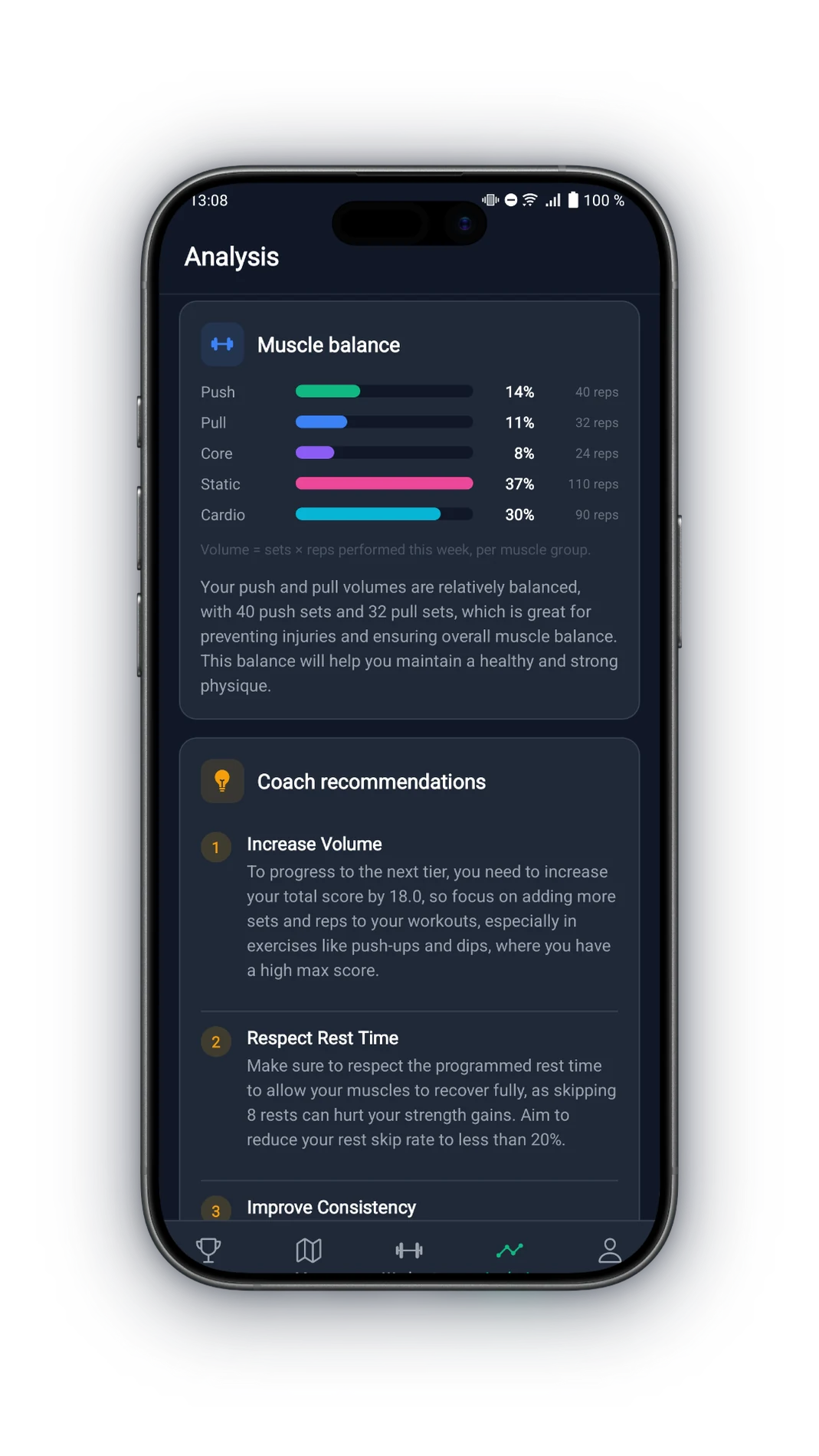
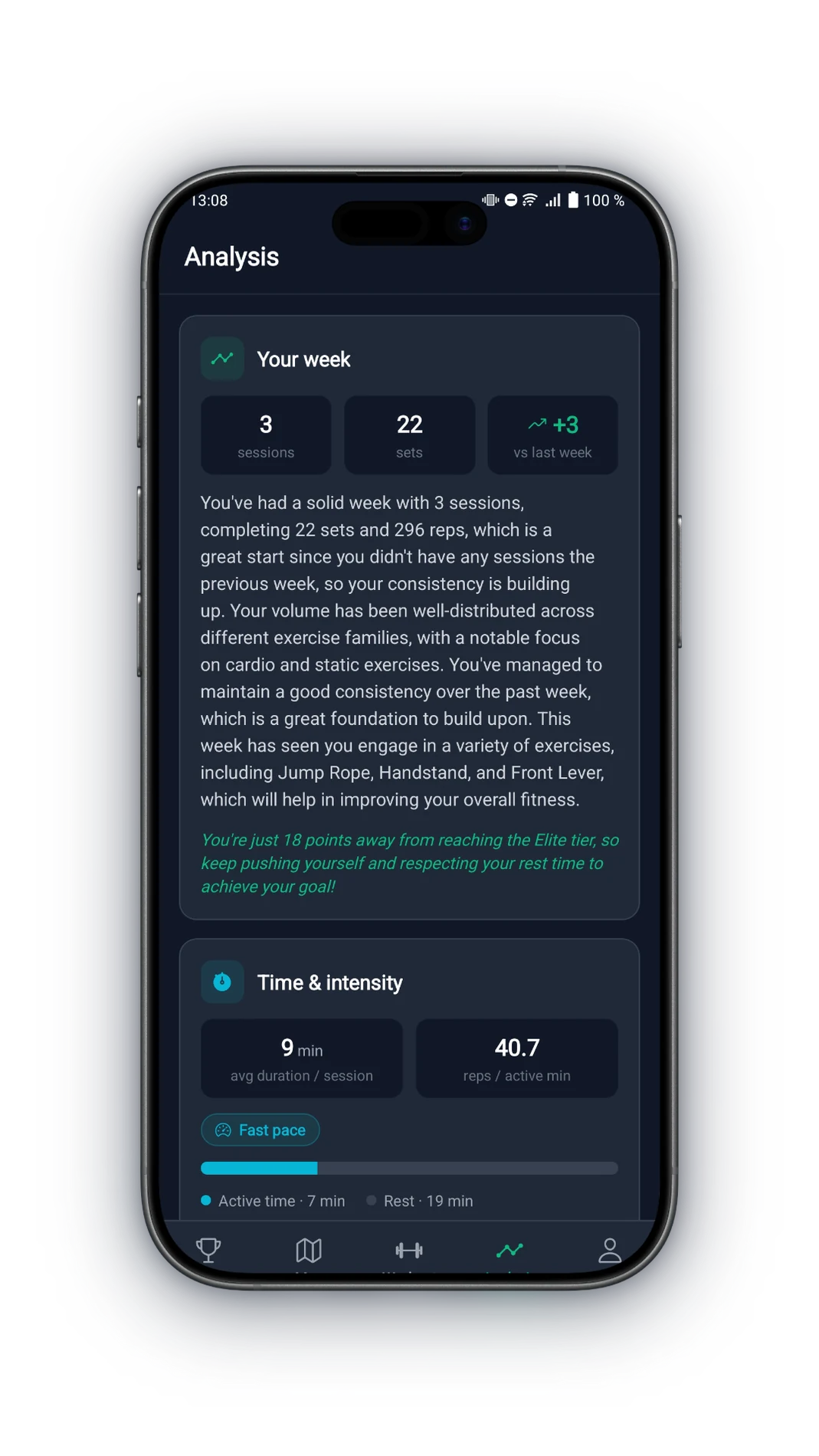
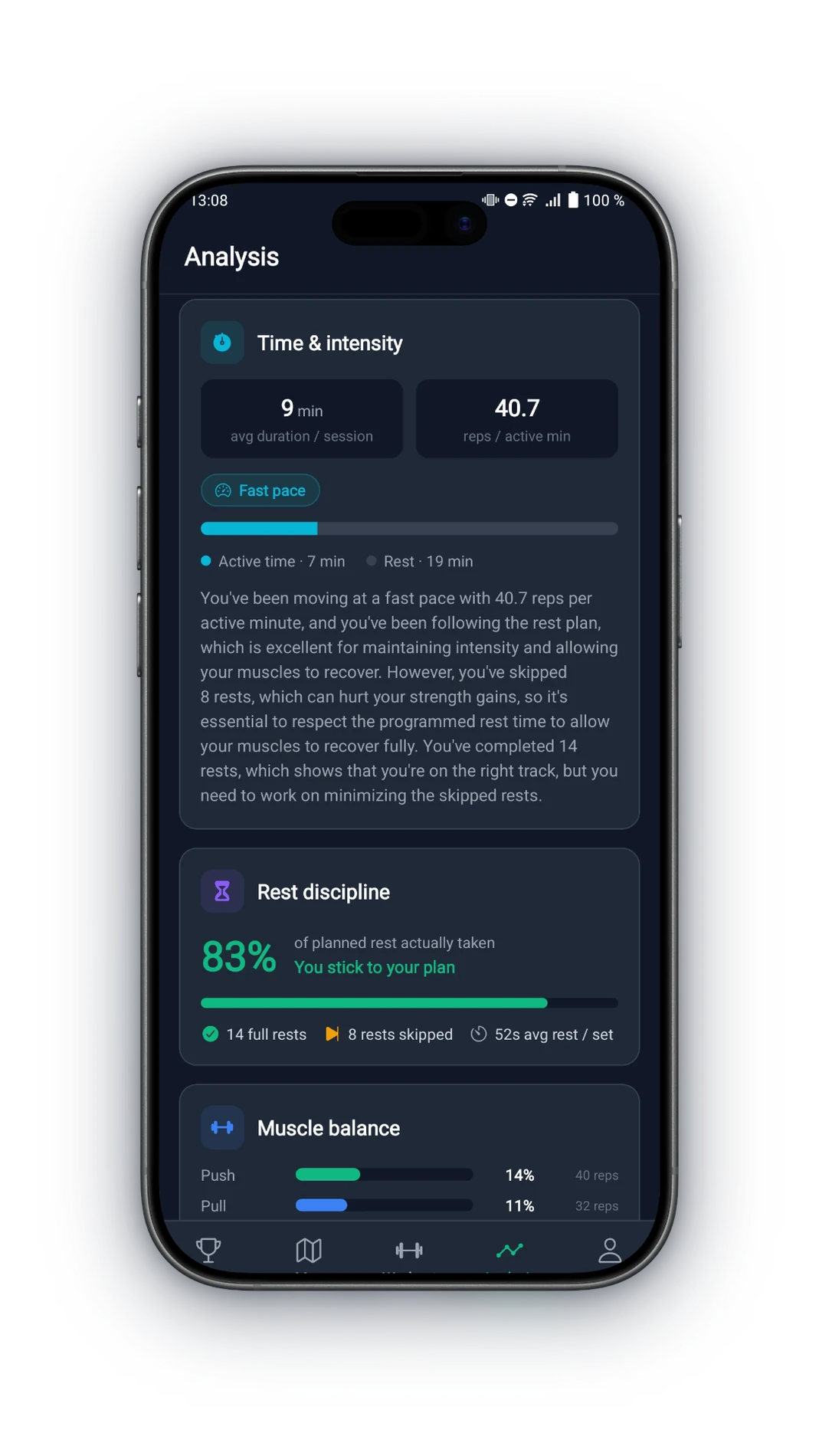
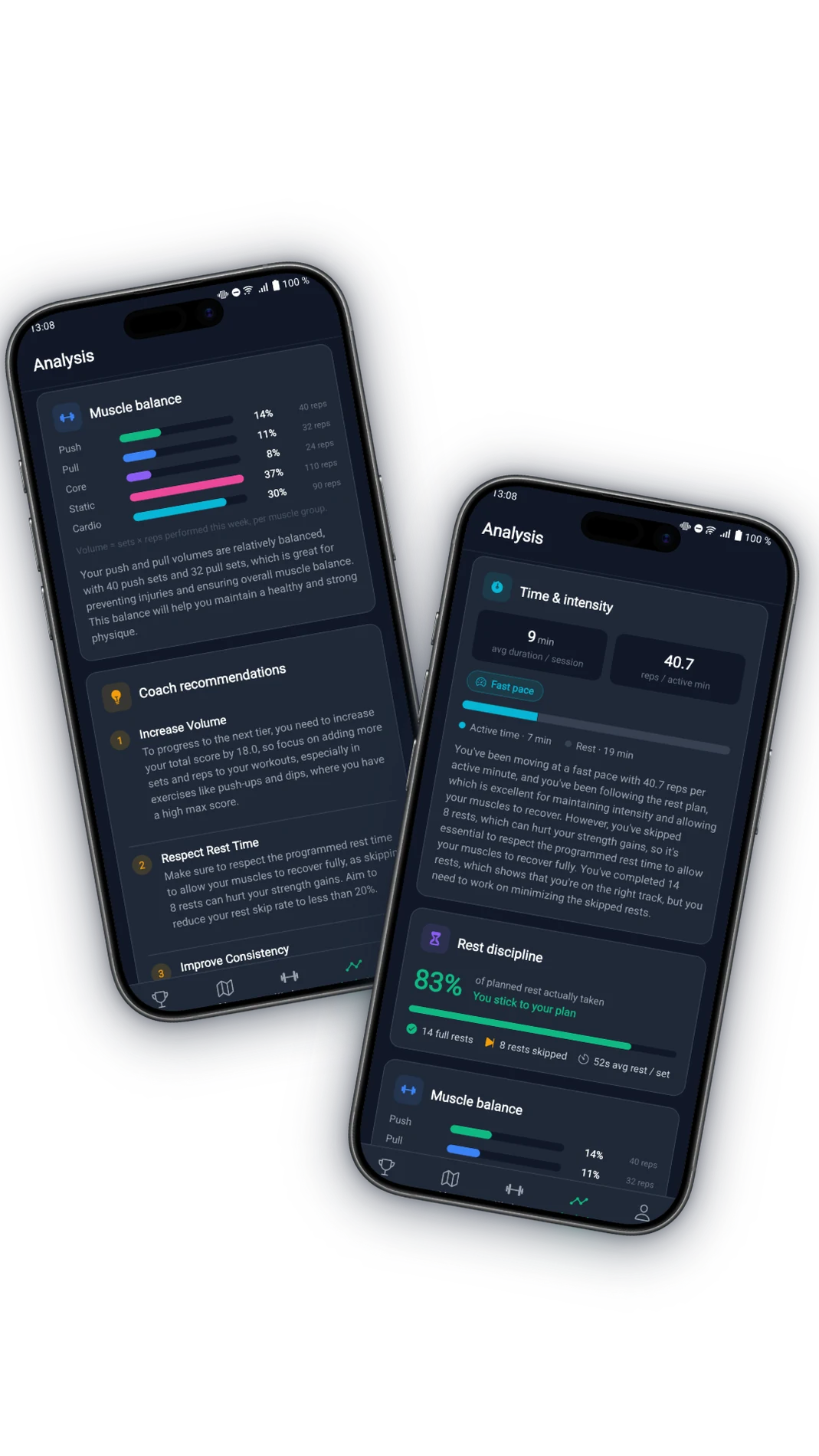
An AI coach that reads your week — volume, balance, pace, rest — and tells you what to fix next.
WHAT IT SOLVES
Logging is just data until something reads it. You can train hard for two weeks and never notice you haven't done a push movement, that your volume dropped 30% — or that you've been skipping half your rest timers and wondering why strength stalled.
HOW IT WORKS
Every week, the AI compares your last 7 days against the week before. Muscle balance as a share of total volume — push, pull, legs, core. Time under the bar: session duration, training pace, active time vs rest. Rest discipline: how much of your programmed rest you actually take, and how often you cut it short. Then a coach-grade recap with three concrete recommendations — including exactly what's missing to reach your next tier.
WHY IT MATTERS
Progress isn't linear. The patterns that quietly kill it — push:pull imbalance, rushed rests, sessions that drift longer while doing less — only show up when something else is paying attention. The numbers come from your real sessions; the AI just tells you the truth about them.

Propose a session. Then both of you show up.

Meet other athletes at a real park, at a real time — and earn points only if the meetup actually happens.

WHAT IT SOLVES
Finding someone to train with is the hardest part of calisthenics. Group chats die, plans slip, and nobody wants to be the one waiting alone at the park.
HOW IT WORKS
Propose a session: pick an athlete, a park, a date and a time. They accept, decline or counter-propose. On the day, you both check in at the park around the planned time — that check-in is what validates the meetup. Upcoming keeps your open proposals, History keeps what happened.
WHY IT MATTERS
A session only counts if both of you turn up, so the points stay honest. Honored session: +10 each, capped at 2 per week. If only one shows: +5 for them, −5 for the no-show.
IN THE TAB
UpcomingHistoryDiscover · soon
SAFETY
16 and upBlock or report from any profilePark check-in validates the session
The Onbars Social tab with a pending training session proposal
In-app explainer: propose a session, show up, earn points, stay safe

Your athlete identity. Earned, not edited.

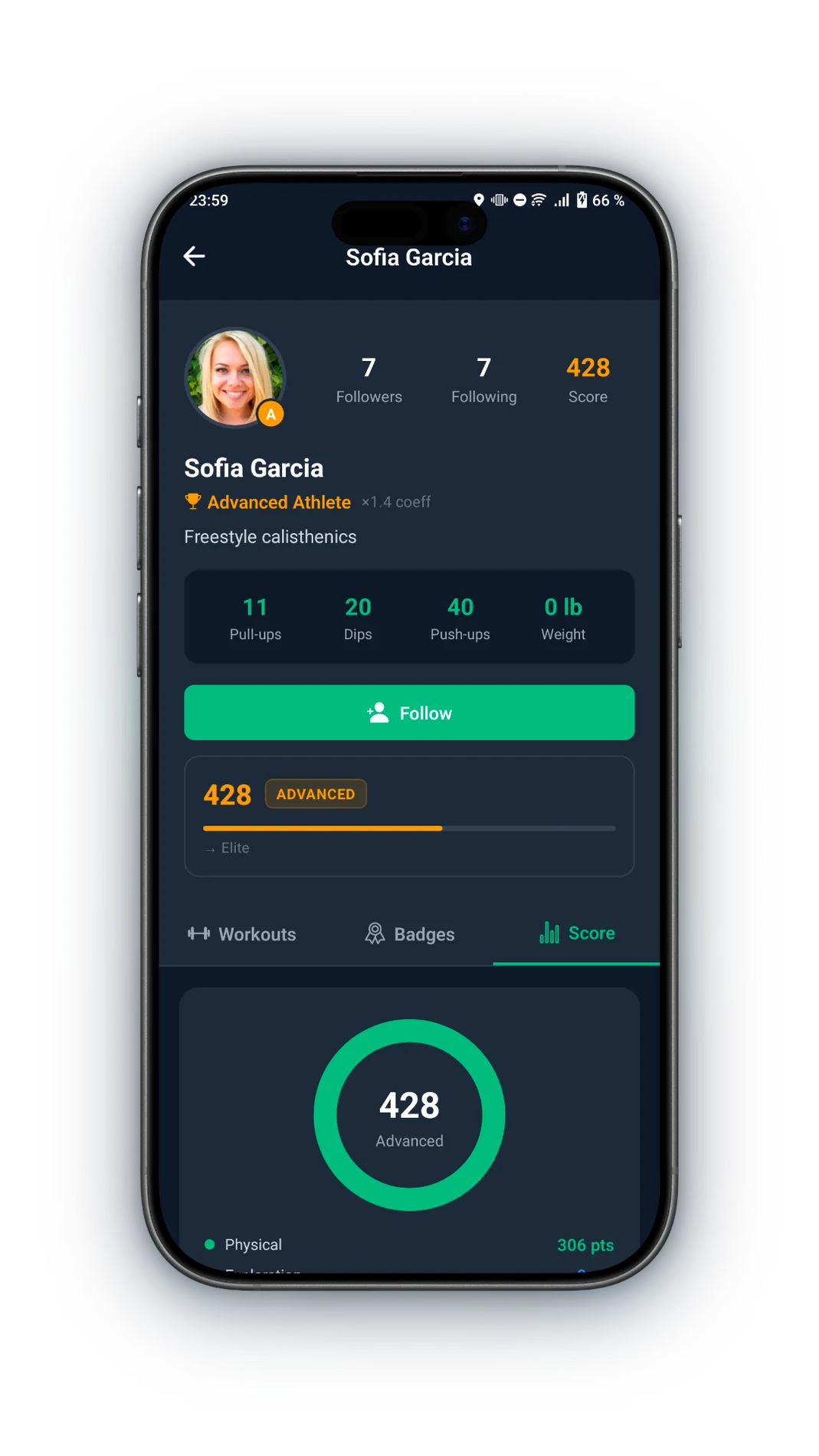
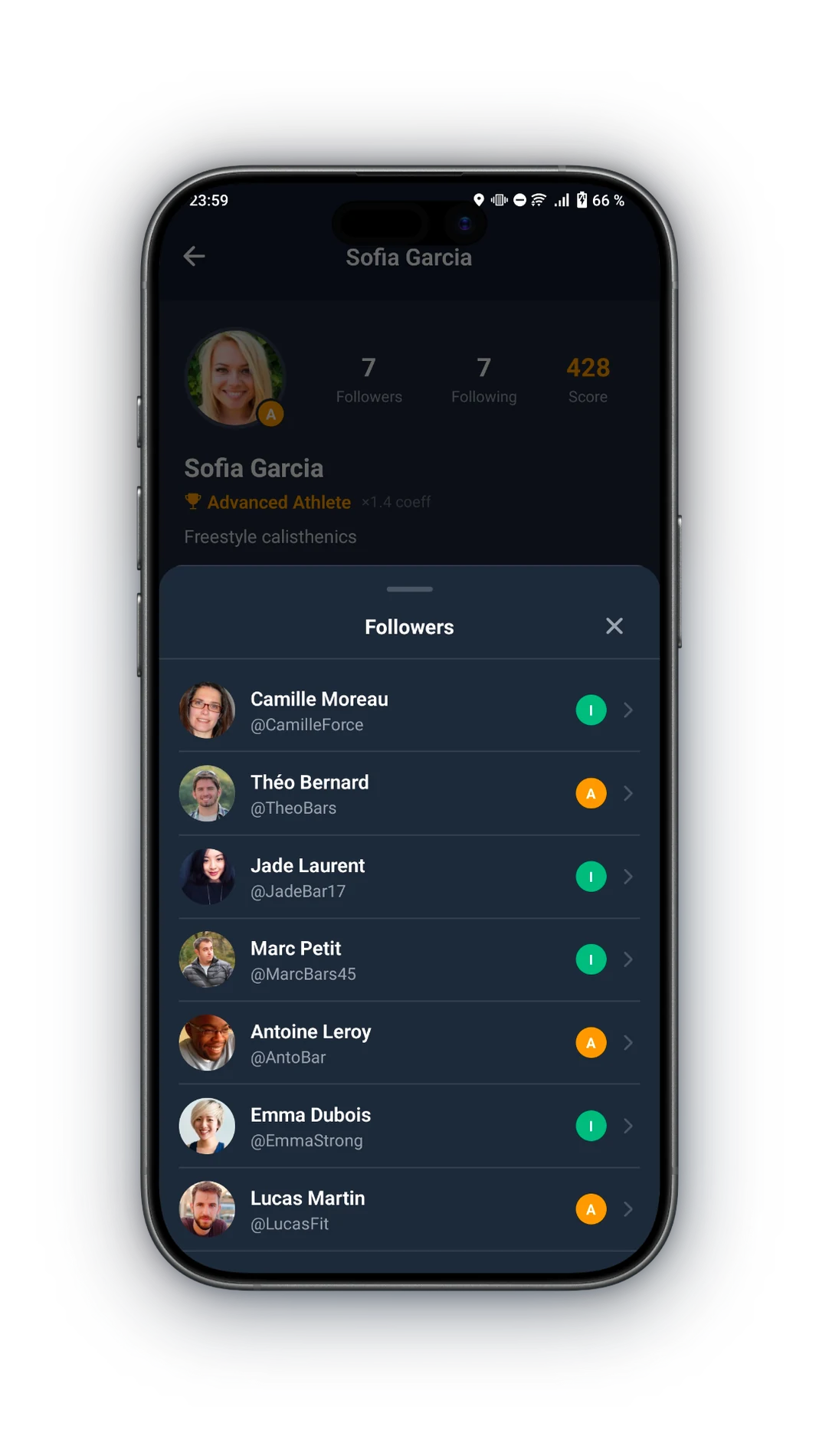
What other athletes see when they open your profile. Score, tier, badges, followers — all evidence-based.
WHAT IT SOLVES
Most fitness profiles are vanity surfaces — a photo, a bio, a fake streak. Yours should be evidence. Numbers other athletes can interpret in 2 seconds.
HOW IT WORKS
A public page showing your Onbars score, tier, verified stats, skill badges, certifications, and followers. Anyone can tap to compare themselves to you, or follow to track your progress.
WHY IT MATTERS
When another athlete opens your profile, they should see exactly what you can do — and what you've proven. No filters, no padding, no shortcuts.

Inside your profile. The full score read-out.

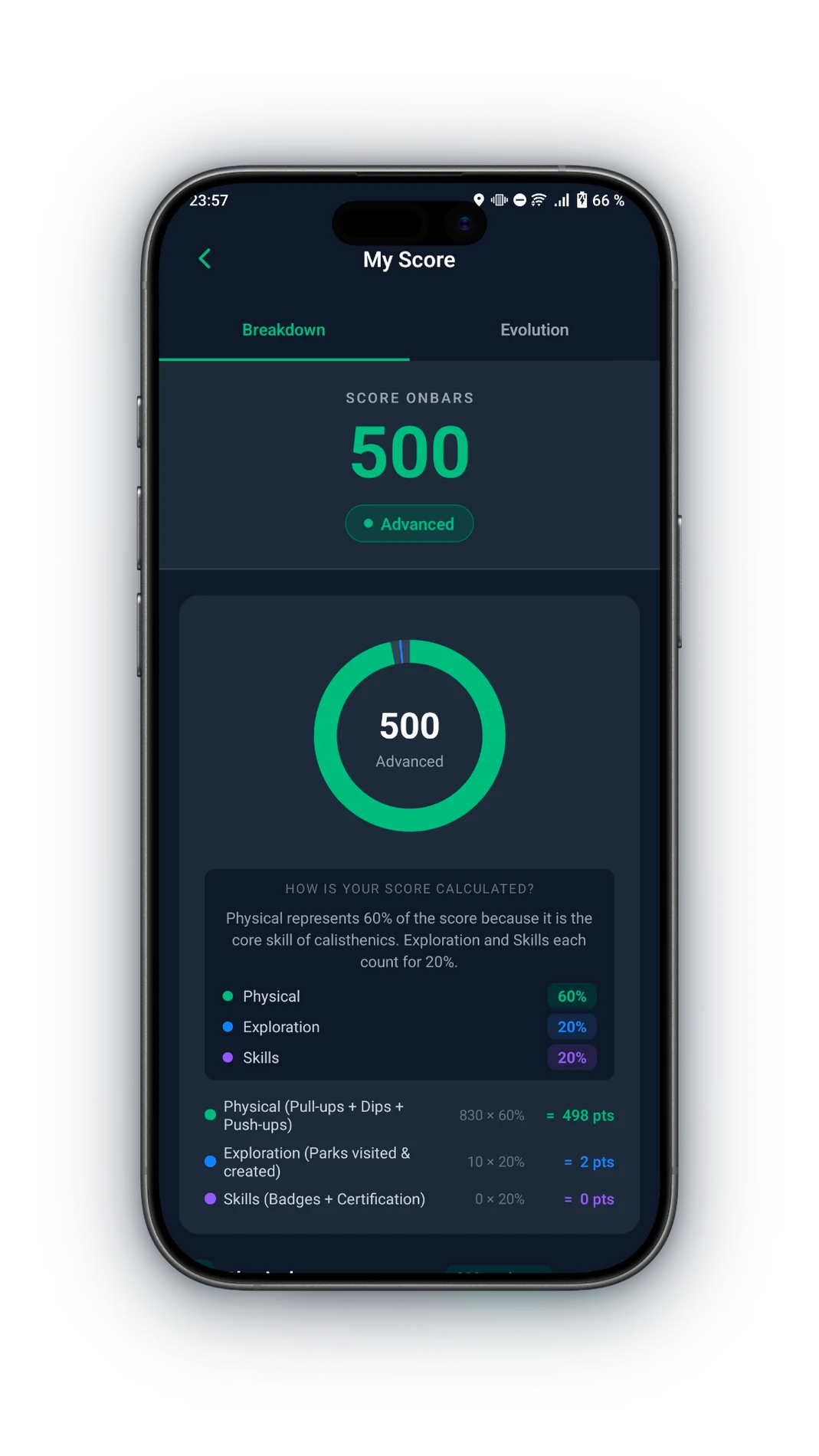
What you see when it's your own profile — score breakdown, evolution, history. The numbers behind the number.

WHAT IT SOLVES
A single score on a card tells you where you stand, but not why. You need to see what's driving it, what's stalling, and what's moved in the last weeks.
HOW IT WORKS
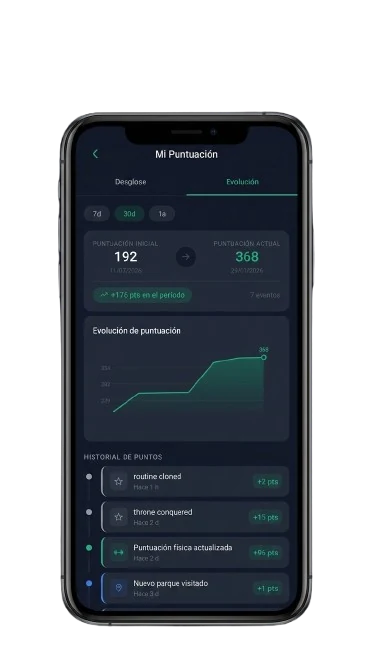
Tap your score to open the full breakdown: 60% Physical, 20% Social, 20% Interaction — with the exact points coming from each. See your score evolution over 7 days, 30 days or a year, and the full history of every event that moved it — a throne conquered, a new park visited, a physical stat updated. Tier ladder included: Beginner, Intermediate, Advanced, Elite.
WHY IT MATTERS
Progress only sticks when you can read it. The dashboard turns a score into a story — and tells you the next move.
Score formulaS = (0.6 × Physical) + (0.2 × Social) + (0.2 × Interaction)